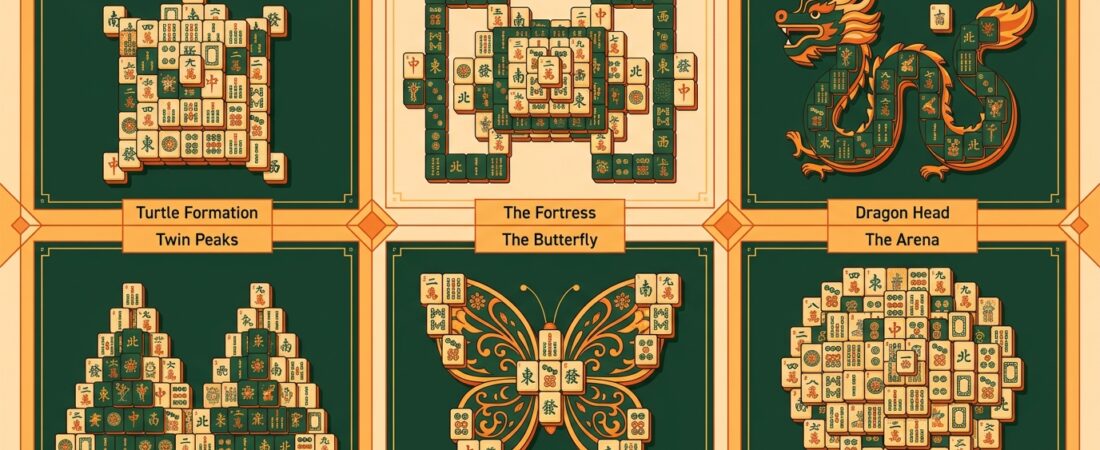
“Mahjong games” is a broader category than most people realize. Under that label sit at least five quite different games, from a 3-minute browser puzzle to a 90-minute table battle. This guide compares all of them so you can pick the one that fits you. To try the puzzle versions right now, browse the All Games page.
The Five Games at a Glance
| Game | Players | Core skill | Typical length |
|---|---|---|---|
| Mahjong Solitaire | 1 | Pattern matching, spatial planning | 3–15 min |
| Mahjong Connect | 1 | Spotting clear paths fast | 5–10 min |
| Chinese Classical | 4 | Probability, hand building | 30–60 min |
| Riichi (Japanese) | 4 | Probability plus defensive discards | 60–90 min |
| American (NMJL) | 4 | Card reading, the Charleston swap | 45–75 min |
Mahjong Solitaire (Matching Puzzle)
Single-player. Tiles stacked into a shape; you remove matching pairs by freeing them from the stack. The classic version, the one that shipped with Windows, is the Turtle layout. Skill is spatial. A game takes 5 to 15 minutes—and on this site, as little as 3 on the easiest layout.
Mahjong Connect (Path Matching)
Single-player. Tiles laid flat in a grid; you remove matching pairs by drawing a path between them that bends no more than twice. Also called Shisen-Sho or 连连看. Skill is visual: spotting clear paths across the board. See our Solitaire vs Connect guide for a head-to-head.
The Table Game Family
Chinese Classical is the ancestor: four players, draw-and-discard, hand building, scoring by pattern. Riichi, the Japanese variant, adds the famous riichi declaration and a strong defensive play culture—it is the version behind most modern competitive play and anime depictions. American mahjong, governed by the National Mah Jongg League, plays with an annually changing card of valid hands and opens every game with the Charleston tile swap. All three reward probability and reading opponents over pattern speed. If the table game calls to you, our American rules guide and American vs Chinese comparison go deep.
Frequently Asked Questions
Which mahjong game is most popular?
Globally, solitaire (thanks to Windows). In Asia, the four-player table game. Riichi dominates competitive play in Japan and online; American mahjong thrives in community clubs across the US.
Are these games related?
Only by the tiles. The puzzle variants were invented independently in the 1980s; the table variants branched from the same Chinese ancestor across the 20th century.
Want to try the puzzle side? Browse the All Games page for solitaire layouts, all free.
Where Should a Beginner Start?
With five variants to choose from, the honest starting point is mahjong solitaire—free, solo, and no rules beyond matching. It builds tile recognition in a weekend. From there, pick by region and company: if your friends or local club play American, jump straight to the NMJL card version, because its jokers and Charleston exist nowhere else. If you follow Japanese streams or anime, Riichi is the natural fit. Chinese classical is the historical base everything else grew from, and the best choice if you want the root system of the entire family.