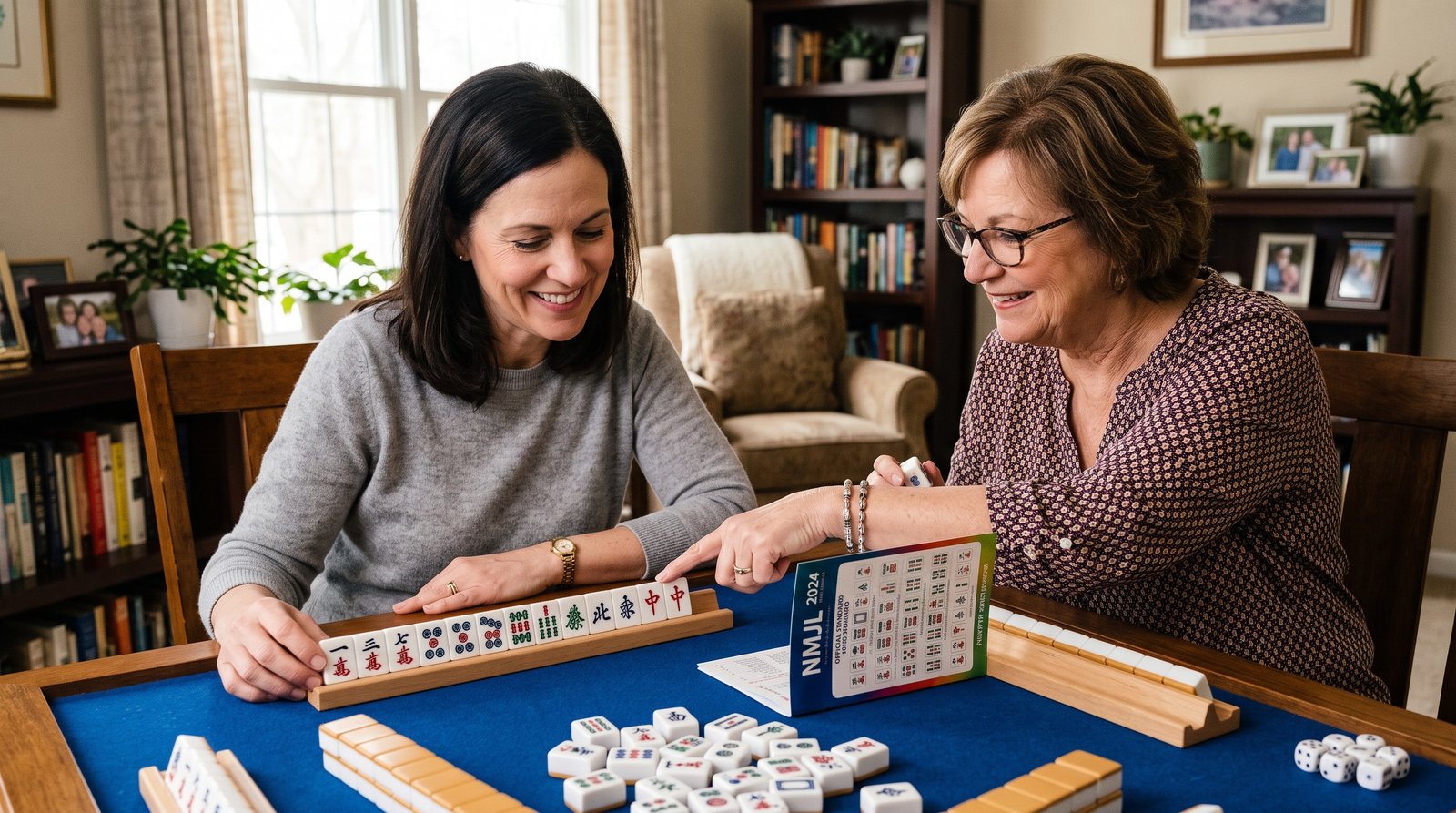
So you want to learn American Mahjong. Good choice. It’s loud, it’s fast, and honestly? It’s one of the most satisfying games you’ll ever play. But when I first started, I felt completely lost. Everyone at the table seemed to speak a secret language. “Pung.” “Kong.” “Charleston.” I just sat there nodding, hoping nobody asked me to do anything.
Here’s the thing though — once you crack the code, it clicks fast. American Mahjong isn’t nearly as complicated as it looks. The rules are logical. The rhythm is learnable. And within a few rounds, you’ll be calling tiles like you’ve done it your whole life.
This guide walks you through the rules from absolute square one. No assumptions about what you know. Just clear, plain-English explanations of how American Mahjong works, what you need to do each turn, and how to actually win a hand.
Let’s jump in.
Wait, Is This the Same as Chinese Mahjong?
Short answer: nope.
American Mahjong is its own thing. It evolved from the Chinese version but went through some serious changes once it hit the States in the 1920s. The biggest differences?
- Jokers. American Mahjong uses 8 jokers. They’re wild. Chinese versions don’t have them at all.
- The Charleston. That’s the passing round at the start of every hand. You’ll learn to love it (or hate it, depending on what you get dealt).
- Hand cards. Instead of memorizing winning patterns, American players use a printed card that shows the legal hands for that year. The National Mah Jongg League (NMJL) puts out a new one annually.
- No Chow. Most American rules don’t allow chows (sequential runs of three tiles in the same suit). Pung and Kong are where it’s at.
So if you’ve played mahjong on a computer or with friends from China, you’ll recognize the tiles but the gameplay is a whole different animal.
What You Need to Play
Before we talk rules, let’s cover the gear.
A standard American Mahjong set includes:
- 152 tiles (versus 136 in the Chinese game)
- 3 suits — Bamboos, Characters, Dots — numbered 1 through 9, four of each
- 4 Winds (North, South, East, West)
- 3 Dragons (Red, Green, White)
- 8 Jokers — the wild cards that make American Mahjong unique
- Flowers (sometimes called Flowers and Seasons) — usually 8 tiles
- Racks to hold your tiles upright so only you can see them
- Your NMJL card for the current year, showing all legal hands
Four players. One set. And ideally, a snack table nearby because games can run long.
Getting Set Up: The Very First Things
You sit down at a square table with three other people. Someone breaks out the tiles and the card.
Choosing Seats
Tradition says you pick seats by rolling dice or drawing tiles. East gets the highest roll or draws the East wind. Then seats go counterclockwise: East, South, West, North. East deals first and also gets to break the wall.
Building the Wall
Everyone builds a section of the wall in front of them. 19 tiles tall, stacked 2 high. That gives you 38 tiles per section. Push them together to form a square. Yes, it’s fiddly. Yes, the wall will probably fall over at least once. That’s part of the experience.
Breaking the Wall
East rolls the dice. Count that many tiles from the right of East’s wall section. That’s where the deal starts. East takes 4 tiles (2 stacks), then South, West, North do the same. Then East takes 4 more. Everyone else takes 4. East takes one more (the “dead” wall is separate). When the dust settles:
- East has 14 tiles
- Everyone else has 13 tiles
East discards one tile face up to the center, dropping to 13. And the game is on.
The Charleston Explained (This Is Important)
Okay, here’s the part that trips up most beginners. The Charleston.
When I first heard “Charleston” I thought it was some dance move. But no — it’s the passing round that happens after the deal but before anyone actually starts playing.
Here’s how it works:
- First pass (right): Everyone passes 3 tiles to the person on their right.
- Second pass (across): Everyone passes 3 tiles to the person directly across the table.
- Third pass (left): Everyone passes 3 tiles to the person on their left.
That’s the standard Charleston. You don’t have to pass if you don’t want to — you can say “no thanks” and keep your tiles. But honestly, passing is usually a good idea. It helps you get rid of suits you don’t need and collect tiles that fit your hand.
There’s also an optional second Charleston where the directions reverse (left, across, right). Your group can decide whether to play with it or skip it. Most experienced players do both rounds.
When the Charleston ends, there’s one more optional step: the Courtesy Pass. Each player can offer one tile to any other player. You don’t have to accept. You don’t have to offer. It’s just a courtesy.
The Charleston is where smart players start forming their strategy. You get a peek at what other people are collecting. You dump tiles you don’t want. You maybe even hint at what hand you’re going for.
The NMJL Card: Your Cheat Sheet
You can’t play American Mahjong without the card. I mean, you can, but it won’t be American Mahjong.
The National Mah Jongg League publishes a new card every year. It lists all the hands you can make. Hands change yearly to keep the game fresh. Some are easy, some are hard, some will make you question your life choices.
The card is organized into sections:
- Quints — hands that use five of a kind (with jokers)
- Kongs — hands built around four-of-a-kind
- Pungs — three-of-a-kind based hands
- Singles and Pairs — hands based on pairs and single tiles
- Consecutive Runs — straight sequences
- Like Numbers — same number across different suits
- Miscellaneous — weird, beautiful, creative hands
Each hand has a point value. Harder hands are worth more points. A simple hand might be 20 or 25 points. A brutal one could be 60 or even 80. The card also tells you which tiles are “singles” — tiles you can only have one of in that hand.
Pro tip for beginners: pick one hand from the card before the Charleston starts. Don’t try to keep multiple options open — you’ll just confuse yourself. Commit to a hand and pass tiles that don’t fit it.
How Turns Actually Work
After the Charleston, East discards one tile. Then the game moves counterclockwise.
On your turn:
- Draw one tile from the wall
- Decide if you want to call for a Pung, Kong, or Mahjong
- If you called a tile, discard one tile
- If you drew from the wall, discard one tile
Simple, right? The tricky part is knowing when you can call tiles out of turn.
When You Can Call a Tile
If someone discards a tile you need, you can call it — but only for certain things:
- Pung: You have two of that tile already. Call “Pung!” to grab it. This stops the person whose turn it normally would be. Pungs are announced face-up on your rack.
- Kong: You have three of that tile. Call “Kong!” Same deal. Kongs also earn you an extra draw from the dead wall.
- Mahjong: You need that tile to complete your hand and win. Call “Mahjong!”
You cannot call a tile for a chow (sequential run) in standard American Mahjong. That’s a Chinese rule. Some groups play with chows, but tournament and NMJL rules don’t allow it.
Here’s a nuance: you can only call a discard from the person immediately before you for a Pung or Kong if you want to. But for Mahjong, you can call from anyone, at any time. Winning trumps everything.
Jokers Are Wild (But There’s a Catch)
Jokers can stand in for any tile except:
- Flowers
- Tiles in a single tile position on the card (marked as “S” for singles)
If you use a joker in a Pung or Kong and someone discards the real tile that joker replaced, they can rob the joker — take your joker and replace it with the real tile, exposing their own completed set. It feels brutal when it happens to you, but it’s a core part of the game. Don’t get attached to your jokers.
Flowers and the Dead Wall
When you draw a Flower tile, you immediately place it face-up on your rack and draw a replacement from the dead wall (the small section separated during setup). Flowers are bonus tiles — they can add to your score but don’t form part of your hand.
The dead wall has its own rules. It’s usually 14 tiles (7 stacks) sitting separately from the main wall. You draw from it when someone gets a Kong or draws a Flower. Once the dead wall runs out, the hand is dead — nobody can win.
How Scoring Works
Alright, you’ve managed to call Mahjong. Now what? You add up your points.
Every hand on the NMJL card has a point value. Standard scoring for 2024-2025:
- Simple hands: 20-30 points
- Medium hands: 35-50 points
- Difficult hands: 55-75 points
Some special situations also add points:
- Mahjong from the wall (self-drawn): +10 points
- Mahjong from a discard: no bonus
- Any Flowers in your hand: +4 points each (or whatever your group agrees on)
- Winning hand has no jokers: usually a bonus
The exact scoring varies by group. Some play for money (quarters per point, for example). Others just play for bragging rights. Decide before you start so nobody gets surprised.
Common Beginner Mistakes
I made every single one of these. Learn from my pain.
- Forgetting to pass during the Charleston. You get caught up looking at your tiles and suddenly everyone’s passing and you’re just sitting there. Always pass. Even if you don’t know what you’re doing yet, pass something.
- Keeping too many options open. American Mahjong rewards commitment. Pick a hand. Go for it. Half-committing means you’ll never complete anything.
- Hording jokers until the end. Use them. They’re tools, not trophies. A joker in your rack does nothing except get stolen.
- Not watching other players’ discards. The discard pile tells you everything. Someone throwing away nothing but Dots? They’re not going for a Dot hand. Someone passing all their Bamboos? They’re probably building a Bamboo hand. Pay attention.
- Calling Pung too early. Exposing a set locks you into that hand. Sometimes it’s better to wait and keep your options flexible.
- Panic discarding. Take your time. There’s no rush. Count the tiles. Look at the card. Breathe.
Etiquette Rules Nobody Tells You
Mahjong is social. There’s an etiquette to it that keeps the game fun for everyone at the table.
- Don’t touch other people’s tiles. Seriously. Just don’t. If you need to see something, ask.
- Announce your discards clearly. “One Bamboo.” “Red Dragon.” It helps everyone keep track.
- Keep your rack upright. Leaning your rack forward is basically cheating — the person next to you can see your tiles.
- Don’t coach other players. Unless someone explicitly asks for help, let them play their own hand. Unsolicited advice at the mahjong table is a quick way to not get invited back.
- Be gracious when you win. And even more gracious when you lose. The game goes in cycles. Your turn will come.
Tips for Your First Game
Okay, you’re about to sit down for your first real game. Here’s what I wish someone had told me:
- Use the card as a bookmark. Literally. Stick your finger on the hand you’re playing so you don’t lose your place.
- Organize your rack by suit. Put all your Dots together, Bamboos together, Characters together. It makes finding what you need way faster.
- Don’t be afraid to ask questions. Mahjong players love teaching new people. Say “wait, can I do that?” as often as you need to.
- It’s okay to lose your first dozen hands. Seriously. Everyone does. The learning curve is about 5-10 games before you start feeling competent.
- Play with the same group if you can. Consistent opponents help you learn consistent habits.
- Watch YouTube games. Seeing the flow in action makes the rules click faster than reading them.
Where to Practice Without the Pressure
The best way to learn American Mahjong is to play. But you don’t need a full table of four people and an NMJL card to get started.
If you want to get familiar with the tiles, the rhythm, and the basic mechanics before sitting down with experienced players, you can absolutely practice solo online. Try American Mahjong online to get a feel for how turns flow, how tiles match up, and how the game builds toward a winning hand. The digital versions handle the boring stuff (like tracking whose turn it is and managing the wall) so you can focus purely on learning the patterns.
Start there. Play a few rounds. Get comfortable with recognizing Bamboos from Dots from Characters. Then sit down at a real table with the confidence that you already know the basics.
Final Thoughts
American Mahjong looks intimidating from the outside. The tiles are covered in symbols you don’t recognize. The players move fast. The card looks like a spreadsheet designed by someone who hates you.
But here’s the secret: everyone who plays it now felt exactly the same way their first time. It’s a game you learn by doing. By losing. By calling Pung at the wrong moment and having someone rob your joker and winning the hand you thought was yours. That’s the game. That’s why it’s so good.
The rules are the framework. The real magic is in the table talk, the friendly trash talk, the collective groan when someone wins on a tile nobody expected. You’ll pick up a hand card and feel lost. You’ll win your first hand and feel like a genius. You’ll lose the next five and feel like you know nothing. And then you’ll come back next week and do it all again.
That’s American Mahjong. Welcome to it.
Frequently Asked Questions
What makes American Mahjong different?
American Mah-Jongg uses a NMJL card (updated yearly), 8 jokers, and the Charleston (a tile exchange at the start). It also uses 152-166 tiles vs the standard 144.
Do I need a NMJL card to play?
Yes, the NMJL card lists all valid hands for the year. It changes annually and costs about $10-15. Many clubs and apps include it.
How long does a game take?
A typical American Mahjong game lasts 15-25 minutes across 4 rounds. Tournament games may run longer with stricter time controls.