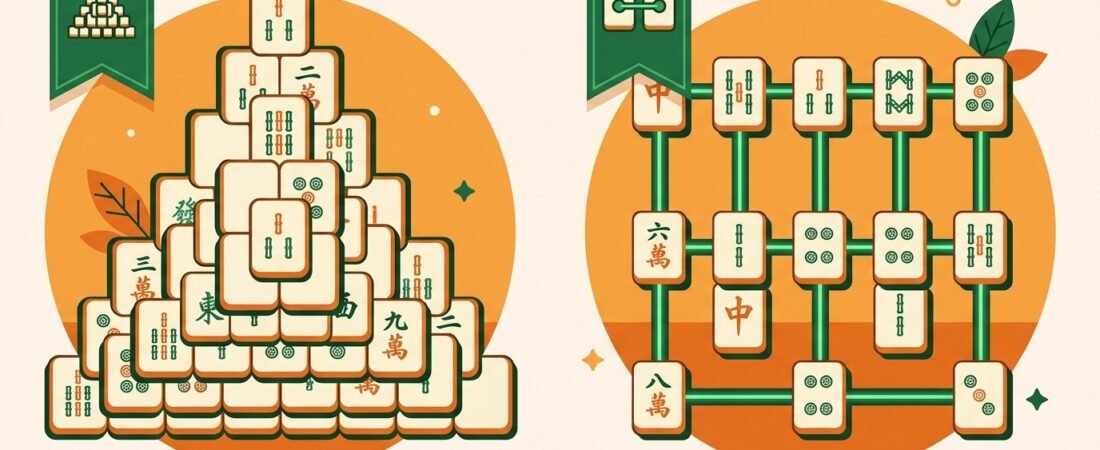
Two solo mahjong puzzles own the browser space: solitaire (the stack-matching game most Westerners know) and connect—also called Shisen-Sho, or 连连看. Same tiles, same matching idea, completely different rules, feel, and strategy. Here’s how each works and how to pick. Both are playable on the All Games page.
The core difference, in one breath
In mahjong solitaire, tiles stack into a 3D shape and you peel matching pairs out of the stack. In mahjong connect, tiles lie flat and you remove matching pairs by drawing a path between them that bends no more than twice. Solitaire is about space. Connect is about paths.
Solitaire: the stack game
This is the one bundled with Windows since 1992—why most players in Europe and North America already know it. A standard layout like the Turtle uses 144 tiles stacked into a shape. A tile’s playable when nothing sits on it and at least one long edge is free. The depth comes from spatial reasoning: which pair you pull first changes what’s playable next.
Connect: the path game
Connect (often sold as Mahjong Chain or Mahjong Trails) lays tiles flat in a grid or pattern. To remove a pair, you have to be able to draw a line between the two that turns no more than twice and doesn’t cross any other tile. The puzzle is visual—you’re scanning for two matching tiles with a clear path, usually along the empty border around the layout.
Which is easier?
Solitaire, for most people. The playable rule (free on top, free on one side) you can see at a glance. Connect is harder on the eyes at first, because you have to imagine invisible paths across the board. Once the path rule clicks, connect turns into something fast and almost meditative—while solitaire stays closer to a logic puzzle.
Which is more popular?
- Global — solitaire is the more-searched term in English, Spanish, most European languages. The Windows legacy did a lot of the work.
- Asia — connect (as 连连看) is enormous in China, Japan, Korea, where it started and where most mobile versions come from.
Honest answer: learn both. They train different skills, and even with the same tiles they feel refreshingly different.
Questions people actually ask
Are solitaire and connect the same game?
No. Same tiles, same matching idea, different rules—solitaire pulls tiles out of a 3D stack, connect removes them by drawing a path with at most two turns.
Which should I play first?
New to both? Start with solitaire. The playable rule reads easier, and most of our strategy tips apply right away.
Can I play both here?
Yes. The All Games page has both styles plus seasonal variants—free, in your browser.
Ready to try? Start with the Turtle for solitaire, or poke around the connect-style games on the All Games page.
What Each Variant Trains
The two variants exercise different parts of your puzzle brain. Mahjong Connect is a pattern-matching sprint: tiles sit in a flat grid, and the challenge is spotting legal paths—at most two bends—under time pressure, which trains raw scanning speed. Trails layouts in mahjong solitaire are a planning exercise: stacked tiles and narrow corridors force you to think several moves ahead, because one early wrong match can block the corridor entirely. Alternate between them and the skills cross-pollinate—faster eyes from Connect, deeper planning from Trails.
Frequently Asked Questions
What is the main difference between solitaire and connect?
Solitaire uses stacked tiles and you match from the outer edges inward. Connect uses a flat grid and you match by drawing a line with no more than two turns between identical tiles.
Which is harder?
It depends on the layout, but Connect often requires faster pattern recognition because tiles sit in a single layer and the connecting-line rule adds complexity.
Do both use the same tiles?
Yes. Both variants use the standard 144-tile mahjong set. The rules are completely different but the tile faces are identical.