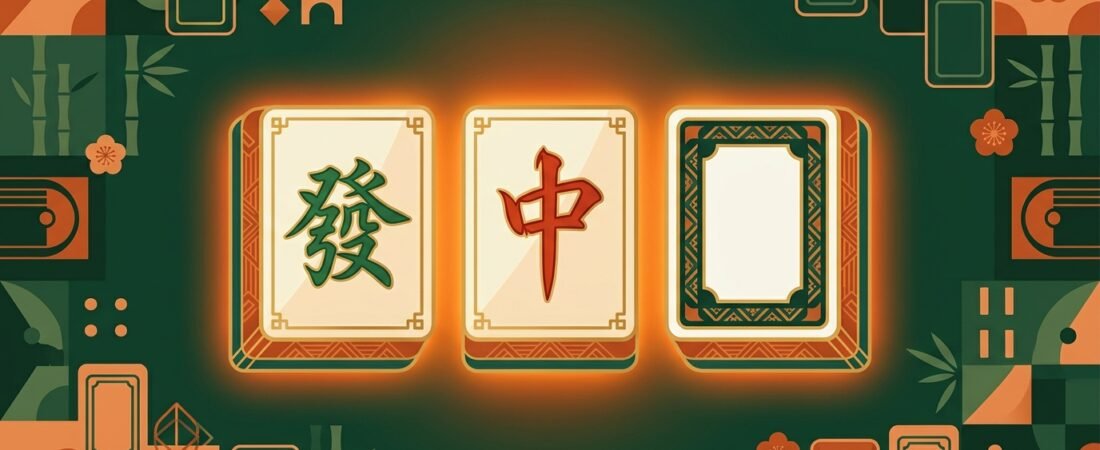
Three of the most striking tiles in a mahjong set are the Dragons: a bold red character, a bold green character, and a blank white tile. Like the Winds, they appear four times each on the board and only match their own kind. This guide explains what each Dragon looks like, what it means, and how to recognize it instantly. For the full tile reference, see Mahjong Tiles Meaning.
Red Dragon (Zhong)
The Red Dragon shows a single Chinese character in red ink: “zhong,” meaning “center” or “middle.” It is the easiest Dragon to spot because of its solid red color. In the table game it is the highest-scoring Dragon of its suit family; in solitaire it is simply a bold, fast-to-recognize match.
Green Dragon (Fa)
The Green Dragon shows the character “fa,” meaning “to get rich” or “prosperity,” in green ink. It is the only green character tile in the set, which makes it impossible to confuse once you know what to look for. Culturally it is associated with wealth and good fortune.
White Dragon (Bai)
The White Dragon is the subtlest of the three. In most modern sets it is a plain tile with a blue rectangular border and no character at all (the character “bai,” meaning “white,” is implied). In older or decorative sets it may be entirely blank. New players sometimes mistake it for a blank or a missing tile; it is a real, matchable Dragon.
Frequently Asked Questions
Do the three Dragons match each other?
No. Each Dragon matches only its own kind. A Red matches a Red, never a Green or White.
Why is the White Dragon blank?
Its character, “bai,” literally means “white” or “blank,” so the tile is traditionally left undecorated, with at most a blue border to mark it as a Dragon.
Want to study the Dragons? The Classic layout lays every tile out flat for easy viewing.