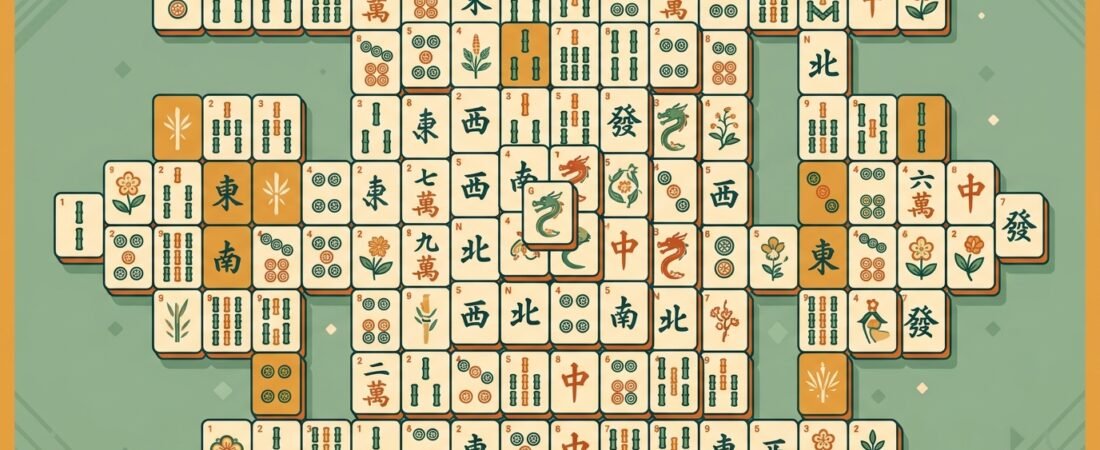
A mahjong set has 144 tiles, every one painted with a symbol pulled from centuries of Chinese culture. You don’t need to read any of them to play—matching works on identical pairs—but once the symbols click, you spot pairs faster, and the whole game opens up into something richer. This guide walks through every family: the three suits, the honors, the bonuses. For the matching rules themselves, the Mahjong Solitaire Rules guide is the place.
The three suits
Three suits hold up the tile set, and each runs 1 through 9. Four identical copies of every tile live on the board, so for any suit-rank combo (Bamboo-4, say) there are four tiles that all pair with each other.
Dots (the circles)
Dots show circles laid out from one to nine. Dots-1 is a single big circle; Dots-9 is a tidy three-by-three grid. They’re said to stand for coins—the suit of merchants and trade.
Bamboo (the sticks)
Bamboo shows vertical sticks, again one through nine—with one oddity. Bamboo-1 doesn’t show a stick at all; it shows a bird, usually a sparrow or a peacock. Bamboo is the suit of farmers and the harvest.
Characters (the cracks)
Characters put the Chinese numeral (one to nine) above the character for “ten thousand”—myriad. These are the calligraphy tiles, the suit of scholars and learning.
The honors
Four Winds and three Dragons round out the core. Each shows up four times.
Winds: East, South, West, North
The four Winds wear Chinese characters for the compass points. East carries the most weight in traditional play (it’s the dealer’s wind), but in solitaire all four are just matching pairs—no hierarchy.
Dragons: Red, Green, White
Dragons are the easy ones to spot. Red Dragon is a bold red character (zhong, “center”); Green Dragon is green (fa, “wealth”); White Dragon is usually a plain blue frame, or in older sets, completely blank.
The bonuses: Flowers and Seasons
Eight bonus tiles finish the 144, and they bend the matching rule in your favor.
The four Flowers
Plum, Lily (or Orchid), Chrysanthemum, and the Bamboo-flower—numbered 1 to 4. Any Flower matches any other Flower, picture be damned. Match two Flowers and they vanish on the spot, a new tile drawn in to replace them.
The four Seasons
Spring, Summer, Autumn, Winter—also 1 to 4. Any Season matches any other Season, regardless of which one’s shown. Same replacement trick.
Spotting pairs fast
- Don’t trust color alone. Two red tiles might be a Red Dragon and a Dots-1—and they don’t match.
- Match by family first: a Bamboo-3 only ever matches another Bamboo-3.
- Treat Flowers as one tile, Seasons as one tile. A Flower and another Flower, anywhere on the board, are a pair.
- Stuck? Scan for Winds and Dragons first. Their designs pop, and clearing them often unlocks the rest. The Tips hub has more shortcuts.
Questions people actually ask
Why are there Flowers and Seasons if they don’t match by picture?
They’re bonus tiles borrowed from the four-player game. In solitaire they loosen the matching rule—any Flower matches any Flower—to give the board a few forgiving pairs.
How many copies of each tile are on the board?
Four of every suit tile and every honor tile. Four Bamboo-7s, four East Winds, and so on. Useful for planning: before you match a pair, check where the other two copies are sitting.
Do I need to read Chinese?
Not a bit. You match identical symbols, so you only need to see that two tiles look the same. After a few games most players absorb the handful of characters without trying.
Want to test what you just learned? The Classic layout lays all 144 tiles flat—the easiest way to study the full set while you play.
Frequently Asked Questions
What are the three mahjong suits?
Bamboo (Souzu), Dots (Pinzu), and Characters (Manzu). Each suit has tiles numbered 1 through 9, with four copies of each number (36 tiles per suit).
What are the honor tiles?
The four Winds (East, South, West, North) and three Dragons (Red, Green, White). Each appears four times in a standard set.
Do I need to know tile meanings to play solitaire?
No — you only match identical symbols. Learning the meanings helps with strategy (recognising tile distributions) but is not required.