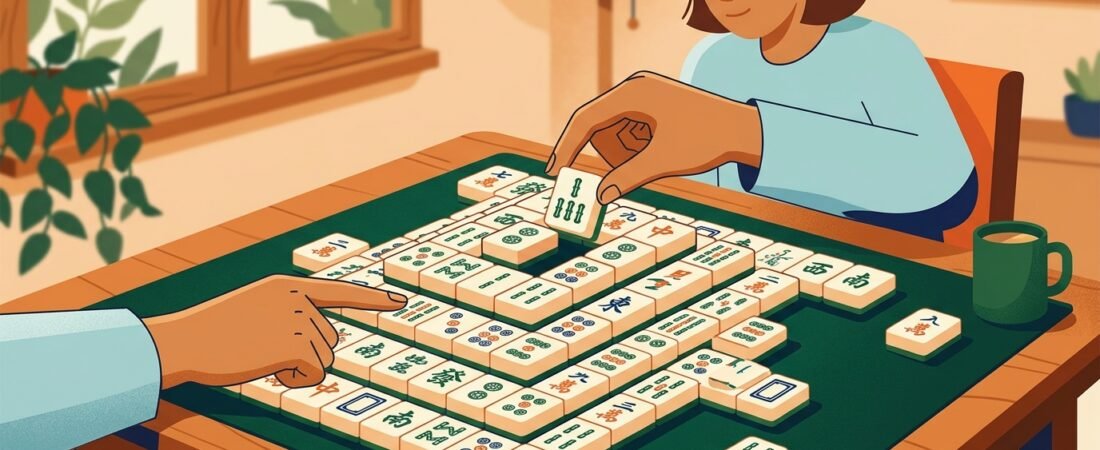
You’ve probably seen mahjong solitaire somewhere—a glowing turtle of tiles on some game site, maybe, or that pyramid your aunt plays on her tablet. Good news: it takes about ninety seconds to learn, and you don’t need to install a thing. Match pairs, clear the board, done. This short walkthrough gets you from “what am I even looking at” to your first finished game, using the Turtle layout most people start with (or the flatter Classic board, if you’d rather).
So what is mahjong solitaire, exactly?
Quick clarification, because the name trips everyone up. The four-player mahjong your grandmother might have played—with all the shouting, the winds, the betting—that’s a different animal. What we’re doing here is the solo version. 144 decorated tiles, stacked into a shape (turtle, pyramid, butterfly), and you take it apart pair by pair.
One rule decides everything else: a tile is playable only when it has a free long edge and nothing sitting on top of it. That’s it. Sounds simple. It isn’t, quite—and that gap between “sounds simple” and “actually simple” is where the game lives.
How a round works (three moves)
- Choose a shape. Start on the Turtle. It’s the 144-tile layout most guides—including this one—assume you’re using, and it has been the default for going on twenty years.
- Match two identical tiles. Click a tile, it lights up. Click its twin, both vanish. Tiles you can’t use stay dim; the ones you can will glow faintly when your cursor lands on them.
- Keep going until the board’s empty. Stuck before that happens? Hit Hint, or Shuffle. Both are built into every layout here—no paywall, no “unlock for $2.99” nonsense.
Picking your first layout
The shape picks the fight, really. Three that won’t punish a newcomer:
- Turtle — the default for a reason. Forgiving, well-documented, and the one every beginner tutorial (this one included) is written around.
- Classic — flat and symmetrical. Less chaos, more planning. Some people never leave it.
- Butterfly — wide open, fast to finish. Five minutes, give or take, if you’re paying attention.
From there the library opens up—25-plus layouts at last count, with seasonal shapes rotating in for Halloween, Christmas, and the long days of summer.
Beginner tips (the ones that actually help)
- Scan the top of the stack first. Side tiles look tempting, but clearing upward unlocks the most options.
- Hold onto your Hint. Burning it on the first tricky pair is the classic mistake—save it for when you’re genuinely stuck.
- Each tile exists four times on a 144-board. Before you match a pair, glance at where the other two copies are hiding.
- Shuffle is a reset, not a rescue. It scrambles whatever’s left, and that can wreck a position you were quietly winning.
- Miserable on a layout? Bail. Switch shapes, no penalty. The strategy hub goes deeper if you want it.
Questions people actually ask
Is mahjong solitaire actually free?
Yes—fully. No download, no account, no “first three levels free” trick. Load the page, play.
Do I have to install anything?
Nope. Runs in any current browser—Chrome, Safari, Firefox, Edge—desktop or phone.
Which layout should a complete beginner pick?
The Turtle. Every beginner guide is written for it, and the difficulty curve is gentle.
Will it work on my phone?
Yes. Every layout adapts to portrait and landscape, and the tap-to-match on a phone is the same as click-to-match on a laptop.
Ready? Pull up the Turtle and clear your first board. Five minutes, give or take—and oddly satisfying when that last pair clicks away.
Common Beginner Mistakes
- Playing the first match you see. Scan the whole board for 15 seconds before clicking. Look for piles with buried tiles and chip away at those first.
- Ignoring the top layer. Tiles with nothing sitting on them are highest priority. Clear the top, new tiles unlock underneath. Work outside-in like an onion.
- Hoarding the hint button. The hint costs nothing. If you stare more than a minute without finding a pair, hit it. No penalty, no shame.
- Never using undo. Pros undo constantly. The game rewards recognising bad moves, not perfect first instincts.
Which Layout Next?
- Turtle (easy) — Wide and forgiving. Your first win lives here.
- Classic (easy-medium) — Taller tower, slightly more planning required.
- Butterfly (medium) — Fast shallow wings. Perfect for quick breaks.
- Pyramid (medium-hard) — Tall and narrow. Punishes rushing. Forces top-down thinking.
- Seasonal layouts — Spooky, festive, or summery. Same rules, fresh look.
Every layout is free, works on phone and desktop, and requires zero download or registration. Pick a shape, click, and play.
Frequently Asked Questions
Do I need to download anything to play?
No. All 28 layouts on FreeMahjongPlay run directly in your browser. No download, no app, no registration required.
Is mahjong solitaire the same as regular mahjong?
No. Regular mahjong is a 4-player game with betting and complex scoring. Mahjong solitaire is a solo matching puzzle using the same tiles but completely different rules.
Can I play on my phone?
Yes. FreeMahjongPlay works on phones, tablets, and desktops. All layouts resize automatically to fit your screen.
How long does a typical game take?
A Turtle layout takes 2-5 minutes for beginners. Harder layouts like Pyramid can take 10-15 minutes. You can leave and come back anytime.