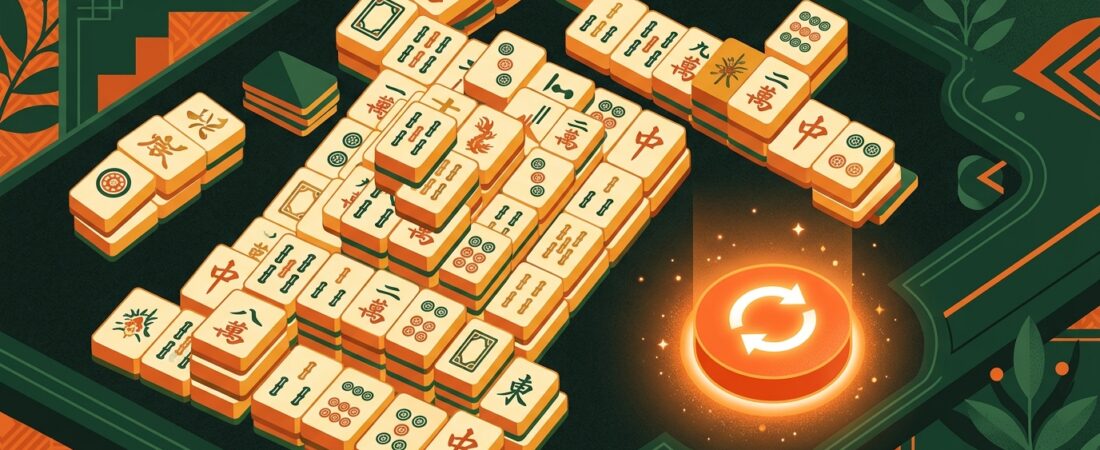
The Shuffle button is the most misunderstood feature in mahjong solitaire. New players treat it as a last resort; some experienced players never touch it. Used well, Shuffle is a tool that saves unwinnable games. Used badly, it throws away winning positions. This guide explains what Shuffle actually does and when to use it. For the broader strategy context, see our strategy guide.
What Shuffle Does
Shuffle takes every tile still on the board, randomly rearranges them into the same layout shape, and lets you keep playing. It does not reset your timer; it only changes where the remaining tiles sit. After a Shuffle, the tiles you have already removed stay gone, and the count of each tile type left is unchanged.
Try the Hint First
A locked feeling is not always a locked board. Before shuffling, use the Hint once: if the game shows you a playable match, the board was never dead—you just could not see it. Our speed guide uses a 5-second rule: if you have not spotted a match in five seconds, take the Hint instead of burning time. Shuffle only when even the Hint has nothing to show you, because that is a genuinely dead position.
When to Shuffle
- The Hint finds no playable match—the position is mathematically dead.
- The only matches available are clearly bad ones that will lock the board.
- You are down to the bottom layers and the remaining tiles are all the same type.
When NOT to Shuffle
- You are mid-game with plenty of matches available; the board is just complex.
- You feel stuck because you are tired, not because the position is locked.
- The board is almost clear; shuffling with few tiles left rarely helps.
Which Layouts Dead-End Most
Dead ends cluster where open edges are scarce. Looking at our measured ratings, the layouts that force the most shuffles are the deep, tight shapes:
| Layout | Avg clear | Why it dead-ends |
|---|---|---|
| Great Wall | 8 min | Few open edges at the start; one greedy match can seal a whole row |
| Gate | 6 min | Two separated columns; strand one side and the other locks too |
| Bullseye | 6 min | Inner ring stays sealed until the outer ring is gone |
| Turtle | 4 min | Rarely dead-ends; the reference layout for clean clears |
If you want shuffle-free practice, play Turtle until you can clear it without a single shuffle. Then take the same discipline to the hard tier.
Frequently Asked Questions
Does Shuffle hurt my score or time?
Your timer keeps running while you decide, so a slow shuffle costs you seconds, not points. A shuffled clear still beats an abandoned game—use it when you need it.
Can every position be solved without shuffling?
No. Many starting positions and most mid-game dead ends are mathematically unsolvable. Shuffle exists for exactly those moments.
Stuck on a game right now? Open the Turtle layout and practice using Shuffle only when the board is truly locked.