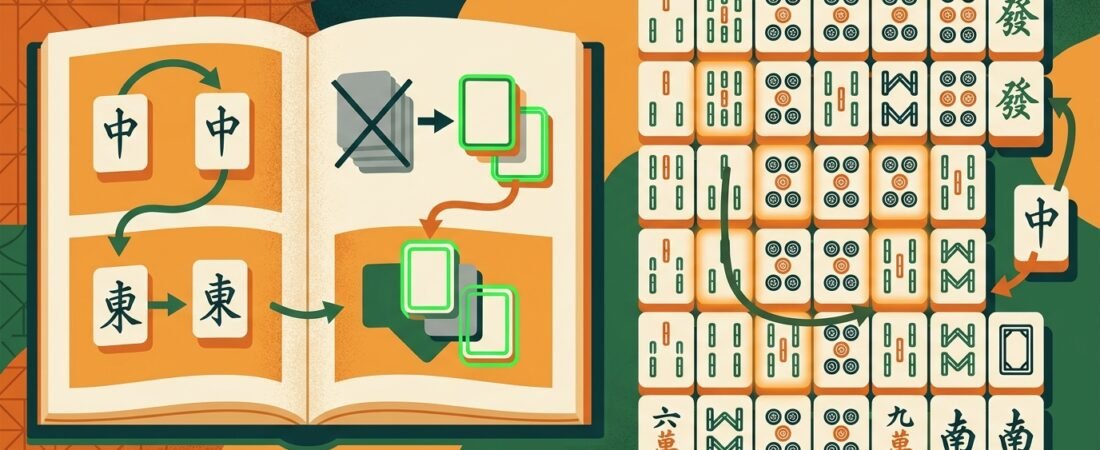
Five minutes to learn, years to get good at—that’s mahjong solitaire in a sentence. Forget the four-player game you might have seen at family gatherings; the solo version has no betting, no opponents, no weird scoring. Just you, 144 tiles, and one rule that runs the whole show. This guide covers the tile set, the matching rule, what makes a tile playable, and how you actually win. For a broader walk through every guide on the site, the Rules hub is the door.
The 144 tiles: what’s actually on the board
Every standard layout is built from the same 144 tiles, sorted into a few families. You don’t have to memorize them to play—but knowing the families helps you spot pairs faster.
- Suits — Dots (circles), Bamboo (sticks), and Characters (the numbers 1–9). Nine ranks in each suit, and four identical copies of every tile on the board.
- Honors — four Winds (East, South, West, North) and three Dragons (Red, Green, White). Again, four copies each.
- Flowers and Seasons — eight bonus tiles. Here’s the trick: any Flower matches any other Flower, any Season matches any other Season, even when the pictures don’t match.
Want the full breakdown of what each tile actually depicts? The Mahjong Tiles Meaning guide goes tile by tile.
The matching rule (the whole game in one line)
Here it is: click two identical tiles, they disappear. A Dots-3 matches another Dots-3, a Bamboo-7 matches another Bamboo-7, an East Wind matches another East Wind. The only wrinkle is Flowers and Seasons—any Flower matches any Flower, any Season any Season, pictures be damned.
What makes a tile playable?
Not every tile you can see is one you can grab. A tile is playable only when:
- nothing is sitting directly on top of it, and
- at least one long edge (left or right) is free—no tile touching that side.
Playable tiles lighten or glow when you hover. A tile that stays dim? It’s pinned on top, or hemmed in on both long sides, and it stays locked until you clear whatever’s holding it.
Winning and “losing”
You win when the board is empty. You “lose,” technically, only when no matches remain and tiles are still sitting there—but in practice you never really lose, because every game here has a Shuffle button that rearranges what’s left into something solvable. The actual challenge isn’t avoiding failure. It’s clearing the board cleanly—as few hints and shuffles as you can manage.
Scoring and time
Most online versions score on three things: time, number of matches, and a bonus multiplier for quick consecutive matches. Lower time, fewer hints, higher score. Here your best time on each layout lives locally in your browser, so you can chase a personal record without ever logging in. Beat it, and the game flags a new record on its own.
Questions people actually ask
Do I need to know the four-player rules first?
No. Solitaire shares nothing but the tiles. No turns, no opponents, no scoring quirks—it’s a matching puzzle.
Can every layout be solved?
Most are solvable from the start, but a careless run of matches can lock the board. That’s exactly what Shuffle is for.
How long does a game take?
A Turtle layout runs about 8–12 minutes for a beginner, 3–5 for someone who’s played a while. Smaller layouts like Butterfly can finish in under three.
Ready to put the rules to work? Open the Turtle layout and clear a board today.
Frequently Asked Questions
What is the main rule of mahjong solitaire?
Match identical pairs of free tiles to remove them from the board. A tile is free when no other tile sits on top of it and at least one long edge (left or right) is open.
What happens if no moves are left?
Use the shuffle button to rearrange remaining tiles, or the hint button to find a valid pair. If no pairs exist at all, the game ends and you can restart.
Are all mahjong solitaire rules the same?
The core matching rule is universal, but layout shapes, tile counts, and special features like shuffles/undos vary between platforms.
What do the different tile symbols mean?
Mahjong tiles come in three suits (Bamboo, Dots, Characters), plus Honor tiles (Winds, Dragons) and Bonus tiles (Flowers, Seasons). You match identical tiles — you do not need to know the meanings to play.