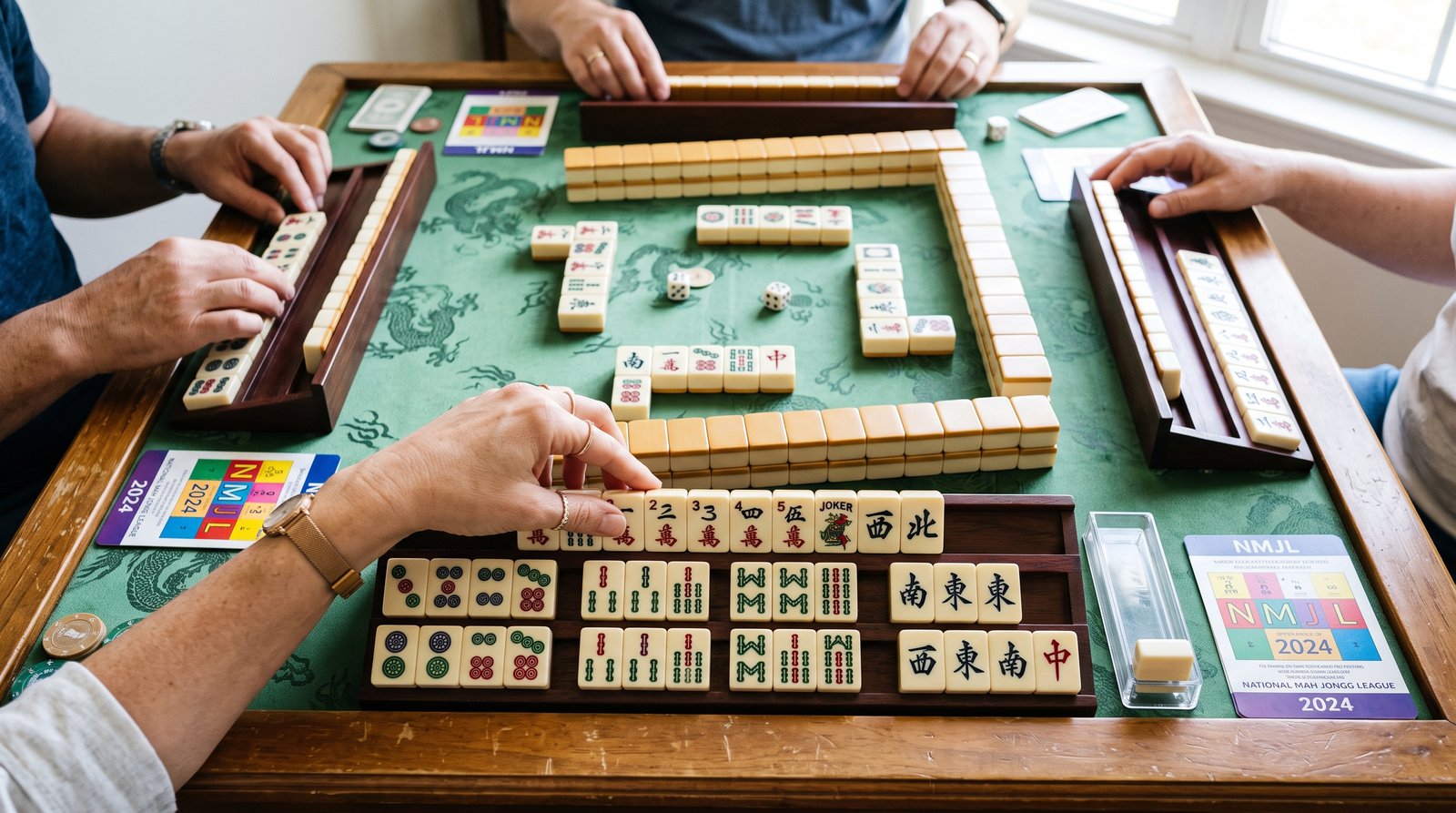
So What Exactly Is the NMJL Card?
If you’ve walked into a mahjong parlor or sat down at a friend’s table, you’ve probably seen it. That little booklet. The one everyone guards with their life. That’s the NMJL card. And honestly? It’s the single most important thing in American Mahjong.
NMJL stands for the National Mah Jongg League. They’re the organization that’s been running American Mahjong since 1937. Every year, they release a new card. And that card changes everything.
Here’s the thing — you can’t play American Mahjong without it. You literally can’t. The card tells you which hands are playable for that year. All the combinations. All the special patterns. It’s your rulebook, your cheat sheet, and your strategy guide all rolled into one.
When I first started playing, I didn’t get it. I mean, I understood the tiles and the basic idea. But the card? It looked like a spreadsheet from hell. Little numbers and letters crammed into tiny boxes. My grandmother tried to explain it. I nodded along. Had no clue what she was talking about.
But here’s the beautiful thing — once it clicks, it really clicks. And you’ll wonder how you ever played without it.
The NMJL Card: A Quick History
The National Mah Jongg League was founded by a woman named Viola L. C. Berkeley. That’s right — a woman started the whole thing back in the 30s. She standardized the rules because, before the NMJL, every group played differently. It was chaos. One group’s “mahjong” was another group’s “what are you even doing?”
The yearly card tradition started early. And it’s never stopped. Every April, a new card drops. And experienced players get a little nervous. Why? Because everything you learned last year? Some of it’s obsolete.
What’s Actually on the Card?
Let’s break it down. The card can look intimidating, but it’s really just organized information.
- The hands themselves — arranged in sections by suit and pattern
- Point values — how many points each hand is worth
- The Charleston rules — reminders for passing tiles at the start
- Special hands — like the elusive “Kong” hands and “Singles and Pairs”
By the way, there are flowers and jokers too. Jokers are wild. They can stand in for any tile except for some specific restrictions in certain hands. But mostly? Yes, jokers save you. They’re the holy grail of American Mahjong.
How Do You Actually Read the Thing?
First, find the section headers. The card is divided into sections like “Like Numbers,” “Consecutive Run,” “Winds and Dragons,” “Singles and Pairs,” and “Quints.” Each section has its own logic.
Like Numbers — you need the same number across all three suits.
Consecutive Run — numbers in sequence across suits.
Winds and Dragons — collecting wind and dragon tiles in specific patterns.
Singles and Pairs — the hardest section. Every tile is either a single or a pair. No melds. No pungs. No kongs.
Quints — you need five of something. Since there are only four of each tile in the set, you need jokers. Lots of jokers.
Each box on the card shows the tile composition. Top row is usually your melds or sequences. Bottom row shows the pair. The number next to the box? That’s the point value. 25 points is standard. But some hands are worth 30, 35, or even 40+.
Why Does the Card Change Every Year?
It keeps the game fresh. Imagine playing the same hands year after year. You’d memorize them. You’d know exactly what to go for every single game. That’s boring. The NMJL knows this. So they shuffle things up.
About 75% of the hands stay similar from year to year. But enough changes to keep you on your toes. And the NMJL doesn’t announce what changed. You find out when you buy the new card. People spend the first few weeks of the new season just figuring out what’s different. It’s part of the fun.
Where Do You Get the NMJL Card?
You can buy one directly from the National Mah Jongg League on their website. They’re not expensive — usually around $10 or so. You’ll also see them at local game stores, senior centers, and online marketplaces. The official card has a holographic seal. Look for it. There are fakes out there.
If you’re just getting started and want to practice the mechanics, Try American Mahjong online — it’ll help you get the flow of the game down.
Common Mistakes Beginners Make
I made all of these. Every single one.
Playing from memory. You think you know the hand. But you misremember one tile. Always check the card.
Ignoring the “any like numbers” rule. Some hands have flexibility. Read the small print literally.
Not reading the footnotes. The NMJL card has footnotes. They matter. Miss one and you could call an invalid mahjong.
Tunnel vision. You pick one hand and refuse to switch. But the tiles aren’t coming. Be flexible.
Forgetting about joker limits. Some hands restrict how many jokers you can use. Others ban them entirely.
How to Read the Card Faster
Speed comes with practice. Learn the structure. Use the index. Mark your card with highlighters. Practice with a friend. I keep my card in a plastic sleeve so I can use dry-erase markers on it. It’s a game-changer.
The Difference Between American and Chinese Mahjong Cards
In Chinese Mahjong, there’s no yearly card. The hands are standardized. In American Mahjong, the card IS the game. You’re building one of the specific hands on this year’s card. Both are fun but the NMJL card gives American Mahjong its unique flavor.
Tips for Using the Card in Real Games
Before the game, pick two or three hands. During the Charleston, pay attention to what people pass. Mid-game, check your hand against the card after every few draws. When someone calls mahjong, look at their hand and compare it to the card. Don’t be afraid to ask questions.
Why the NMJL Card Matters More Than You Think
That little booklet connects you to every other American Mahjong player in the world. Someone in New York is looking at the same hands you are. The yearly card creates a shared experience. When a new card drops, everyone discovers the changes together.
And honestly? There’s something special about owning a physical card. In a world where everything is digital, the NMJL card is still paper. It gets worn in your purse. It has coffee stains. Your notes fill the margins.
If you’re new to the game, the NMJL card will feel overwhelming at first. That’s okay. Give it time. Eventually it’ll click. And when it does, you’ll realize what all the fuss was about. The NMJL card isn’t just paper. It’s the heartbeat of American Mahjong. Learn to read it and you’re part of a tradition that’s almost a hundred years old.
Frequently Asked Questions
0
What does NMJL stand for?
1
National Mah Jongg League. They publish the official annual card with all valid hands for American Mah-Jongg.
2
How often does the card change?
3
Every year, usually released in March or April. Approximately 40-60 percent of hands change annually, keeping the game fresh.
4
How do I read the card categories?
5
The card is organized by hand type: Year hands, 2468, Like Numbers, Quints, Consecutive Runs, Winds-Dragons, 369, Singles and Pairs. Each has multiple line variations.