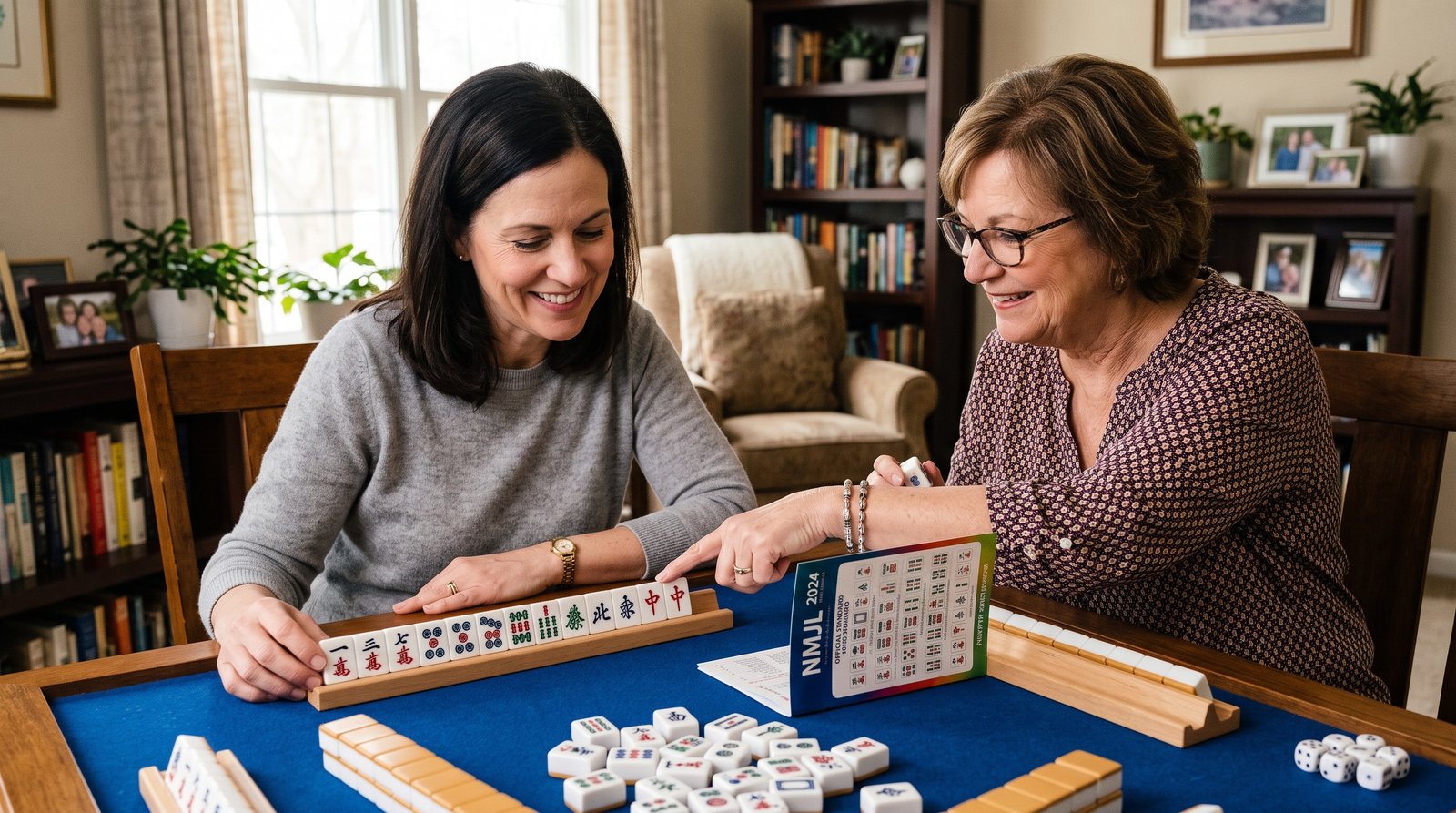
So What Exactly Is American Mahjong?
If you’ve ever walked past a group of people hunched over little tiles, slamming them down with serious intensity, you’ve probably wondered what the heck is going on. That’s American Mahjong. It’s loud. It’s strategic. And honestly? It’s way more accessible than most people think.
When I first started playing, I was convinced I’d never get it. The tiles looked like some ancient code I’d have to crack. But here’s the thing — once you learn the rhythm, it clicks. Fast.
American Mahjong isn’t the same as the traditional Chinese game. Not even close. The American version uses a standardized set of rules, a card system that changes every year, and a whole different vibe at the table. Think of it as the difference between chess and checkers. Both are great. But they’re not the same game.
By the way, if you’re the type who learns better by doing, you can Try American Mahjong online right now and follow along. That’s how I learned. Reading rules only got me so far.
What You’ll Need Before You Start
You can’t play without the right gear. Here’s what you need:
- A Mahjong set with 152 tiles — American sets come with racks and pushers. The tiles include suits, honor tiles, jokers, and flowers.
- The National Mah Jongg League (NMJL) card — This is non-negotiable. The card shows all the winning hands you can play for that year. It changes annually. If your card is from 2023, you’re playing last year’s game.
- Four players — No more, no less. American Mahjong is strictly a four-player game.
- Some patience — Not a physical item, but trust me, you’ll need it.
I remember showing up to my first game with a set I’d bought on Amazon. The tiles were too small. The racks were flimsy. My friends made fun of me. Don’t be like me. Get a decent set. Your fingers will thank you.
The Tiles — What’s What
Let’s break down the 152 tiles real quick. You don’t need to memorize everything right now, but you need to know what you’re looking at.
Suits (1 through 9)
There are three suits: Bamboo (green sticks), Characters (red Chinese characters, also called “Cracks”), and Dots (circles). Each suit runs from 1 to 9, and there are four copies of each tile. So 3 suits x 9 numbers x 4 copies = 108 tiles right there.
Honor Tiles
These are the Winds (East, South, West, North) and the Dragons (Red, Green, White). Four copies of each. That’s 16 wind tiles and 12 dragon tiles.
Flowers
There are 8 flower tiles. The original 4 represent the four seasons. But in the American game, you’ll see letters on them — F, I, S, H on one set. They’re bonus tiles. You don’t use them to form your hand, but drawing one can change your strategy.
Jokers
This is where American Mahjong really separates itself. You get 8 joker tiles. Jokers act as wild cards. They can stand in for almost anything. And they’re the reason the game feels so chaotic sometimes.
The NMJL Card — Your Playbook
I cannot emphasize this enough. The card is everything.
The National Mah Jongg League publishes a new card every year. It lists dozens of possible winning hands, organized by category. You pick one hand to play at the start, and you try to build it. But here’s the catch — you can’t change your hand mid-game. Once you commit, you’re committed.
When I first saw the card, my eyes glazed over. There are so many symbols and abbreviations. But it’s actually pretty logical once you know what you’re looking for:
- Like numbers across suits — For example, 2-2-2 of Bamboo, 2-2-2 of Dots, and 2-2-2 of Characters. Matching numbers in three suits.
- 12347 in two suits — Sequential numbers. These hands are tricky because you need specific tiles.
- Singles and pairs — Some hands are built around a collection of pairs and single tiles. No sequences, no triplets, just chaos.
The card also tells you how much each hand is worth. Some hands are easy to complete but give you few points. Others are insanely specific but pay out big when you hit them.
My advice? Start with the easier hands. The “201” or “202” hands on the card are usually simpler. Don’t go chasing the 50-cent hands your first time out. You’ll just frustrate yourself.
Setting Up the Game
Okay, you’ve got your tiles, your card, and three other people who don’t hate you yet. Let’s set up.
Who Sits Where?
Each direction matters. East is the dealer. South sits to East’s right. West is opposite East. North is to East’s left. You determine East by rolling dice. Highest roll gets to be East. That’s the simplest method, anyway.
Building the Wall
Shuffle all tiles face down. Then each player builds a wall in front of them — two tiles high, 19 tiles long (so 38 tiles per side). Push the walls together to form a square. It looks like a fortress. That’s your draw pile.
The Charleston
This is one of the coolest parts of American Mahjong. Before the game officially starts, players pass tiles around. It’s meant to help everyone improve their hands. Here’s how it goes:
- First pass: Pass 3 tiles to the person on your right.
- Second pass: Pass 3 tiles across from you.
- Third pass: Pass 3 tiles to your left.
Then you can do a “courtesy pass” where you offer one tile to the person on your right, and they can accept or decline. After that, the Charleston is over, and the game begins for real.
I’ll be honest — I messed up the Charleston so many times at first. I’d pass the wrong direction, forget the order, or accidentally pass tiles I actually needed. It happens. You’ll get it after two or three games.
How to Actually Play — Turn by Turn
Alright. This is what you came for. Here’s how each turn works.
Step 1: East Breaks the Wall
East rolls the dice, counts that many tiles from the right side of their wall, and breaks the wall there. The tiles to the right of the break become the dead wall (14 tiles, used for replacement draws). The tiles to the left are the live wall, where everyone draws from.
Step 2: East Draws First
East takes the first four tiles from the live wall (two tiles from the top row, two from the bottom). Then South, West, and North do the same, going counterclockwise. You do this twice. That gives everyone 12 tiles.
Then East draws one more tile (top row only), and everyone else draws one more. Now East has 14 tiles. Everyone else has 13. The game is live.
Step 3: East Discards First
Since East has 14 tiles, they discard one face up into the center of the table. Then the turn moves counterclockwise. Each player either draws from the wall or claims the discard just made.
Step 4: Drawing or Claiming
On your turn, you usually draw a tile from the wall. Add it to your rack. Then figure out if it helps. If not, discard. That’s the basic flow.
But sometimes another player discards something you need. That’s where the special calls come in:
- Take (or “Chow”): You can take a discard if it completes a sequence of three consecutive numbers in the same suit. But here’s the kicker — in American Mahjong, only the person immediately before you can give you a take. So if the person across from you discards something, you can’t take it as a sequence.
- Pung (or “Pong”): You can grab any discard if it matches a pair you already have, making a triplet. This works even if it’s not your turn. Any player can pung.
- Kong: If you have three of a kind and the fourth copy gets discarded, you can call kong. You grab it, expose all four tiles on the table, and draw a replacement from the dead wall.
I distinctly remember my first game where someone punged my tile and I had no idea what just happened. It caught me completely off guard. That’s normal. You’ll learn to expect it.
Step 5: Using Jokers
Jokers are wild. They can stand in for any tile you need. But here’s the rule that trips everyone up — you can’t claim a discard to replace a joker you’ve already used. Once a joker is on the table as part of an exposed meld, it stays there. You can’t swap it out later.
But if you have a joker in your hand and you draw the actual tile it’s replacing? You can swap them during your turn. It’s called a “joker exchange” and it’s one of those small moves that make the game deeper than it looks.
Winning — How to Call Mahjong
The goal is to complete a hand that matches one on the NMJL card. When you do, you yell “Mahjong!” and collect your winnings.
To call Mahjong, you need to either:
- Draw the winning tile yourself, or
- Claim a discard that completes your hand — even if it’s not your turn
And that second option is where things get tense. You could be one tile away, just waiting. Someone discards it, and bam — game over. It feels incredible.
One time I was playing and needed a specific 3 Dot. I sat there for six turns. Nothing. Then my friend, completely oblivious, tossed a 3 Dot into the middle of the table. I nearly flipped my rack over calling Mahjong. She was not happy. That’s Mahjong.
Keeping Score (The Simple Version)
American Mahjong uses a scoring system based on the NMJL card. Each hand has a point value listed on the card — usually from 20 cents to 50 cents (in the standard card). But here’s the thing: scores can grow with bonuses:
- Mahjong bonus: Just for winning, you get extra. If you win with a self-drawn tile (not claiming a discard), your payout is higher.
- Jokerless bonus: If you win with zero jokers in your hand, big bonus.
- Singles and Pairs bonus: Some categories pay differently.
The actual money calculation depends on your group. Some play for dimes and quarters. Some play with tokens. Some just keep a running tally. Don’t stress about the math — ask your group how they score before you sit down.
Common Mistakes Beginners Make
I made every mistake in the book so you don’t have to. Here are the big ones:
- Changing hands mid-game: You declare your hand at the start. Don’t switch. You can’t. I tried. The table will let you know quickly that you messed up.
- Forgetting the joker rule on exposure: If you put a joker in an exposed meld, that joker is locked. You can’t move it. Choose carefully.
- Ignoring the Charleston: The Charleston isn’t optional busywork. It’s your best chance to improve your hand before the real game starts. Take it seriously.
- Playing too many honors: Winds and Dragons look appealing, but they’re hard to complete into winning hands unless the card specifically calls for them. Stick to suits when you’re learning.
- Not reading the card carefully: Some hands look almost identical but have different requirements. Read the fine print. One wrong tile and your hand is invalid.
American vs. Other Mahjong Styles
You might hear people talk about Chinese Mahjong, Hong Kong Mahjong, or Riichi (Japanese) Mahjong. They’re all cousins, but the American version stands apart:
- Jokers: Only American Mahjong uses jokers this way. Other versions don’t have them at all.
- The Card: No other style uses an annual standardized card. In Chinese Mahjong, you memorize the hands. In Riichi, you learn the yaku. Only Americans get a new cheat sheet every January.
- The Charleston: Unique to the American game. Nowhere else do you pass tiles around before starting.
- Exposure rules: American Mahjong is stricter about which discards you can claim and when.
If you ever travel abroad and join a Mahjong game, don’t assume the rules are the same. They won’t be. I learned this the hard way in a Chinatown game in San Francisco. Let’s just say I didn’t win that round.
Tips to Get Better Faster
Want to improve without grinding 50 games? Here’s what worked for me:
- Play online first. Seriously. Nobody judges you, and you can take your time. Try American Mahjong online to practice without the pressure of a real table. That’s how I finally stopped mixing up Bamboo 6 and Bamboo 9.
- Study the card away from the table. Pull up the NMJL card PDF and just read it. You’ll start recognizing patterns faster.
- Watch experienced players. Pay attention to what they discard early. Usually it’s honors or high numbers. They’re thinning their hand toward a specific goal.
- Play defense. Don’t just focus on your own tiles. Watch what other people pick up and discard. If someone picks up two Red Dragons, maybe don’t discard yours.
- Count tiles. I know, it sounds hard. But start small. Just track the jokers. If all 8 jokers are on the table, you know nobody’s getting a jokerless bonus. That kind of awareness changes your decisions.
Ready to Play?
American Mahjong isn’t a game you master in one sitting. It’s the kind of game you slowly fall in love with over months and years. The first time you call Mahjong, you’ll feel it. The first time you pull off a risky hand you weren’t sure you’d complete? That’s the hook.
So grab a set, find three friends, and get started. And if you can’t find three friends right now? That’s fine. Try American Mahjong online and practice until you’re ready for the real table. You’ll be glad you did.
See you at the wall.
Frequently Asked Questions
What is the setup process?
Each player builds a wall of 19 tiles (two high), rolls dice to determine the break, and draws 13 tiles. The dealer draws 14. Then the Charleston begins.
What happens during the Charleston?
Each player passes 3 tiles to the right, then 3 to the left, then 3 across. You may pass jokers. After the first Charleston, you can do a second optional one.
How do you win a hand?
You must assemble a hand matching one of the patterns on the current NMJL card. Declare Mah-Jongg when you complete it. You do not need to draw the final tile.