So, What’s the Real Difference?
If you’ve ever sat down at a mahjong table and felt completely lost, you’re not alone. I’ve been there. When I first started playing, I assumed mahjong was mahjong — one game, one set of rules, end of story. Boy, was I wrong.
Here’s the thing: American mahjong and Chinese mahjong are basically cousins. Same family, completely different personalities. They share a DNA of tiles and melds, but everything else? Night and day.
The Tiles Look the Same — Until They Don’t
Both versions use the classic tile suits: bamboos, characters, and dots. You’ve got your dragons and your winds. So far, so identical, right?
But here’s where it gets interesting. American mahjong adds something the Chinese version doesn’t have at all: the joker. Eight of them. These little wild cards can stand in for any tile you need, and they completely change how you think about the game. Chinese mahjong? No jokers. No shortcuts, no wild cards, no mercy.
American sets also usually come with racks — those little plastic stands that hold your tiles upright. In Chinese mahjong, you just pile your tiles in front of you. Oh, and American mahjong tiles often have Arabic numerals engraved in the corner. Chinese tiles don’t. If you’re still learning to recognize the suit symbols, those numbers are a lifesaver.
The Charleston Changes Everything
In American mahjong, the game starts with “the Charleston.” Every player passes three tiles to the right, then across, then to the left. There’s strategy in what you let through. Chinese mahjong doesn’t do this. You get your tiles, organize them, and start playing. Simple. Direct.
Card vs. No Card
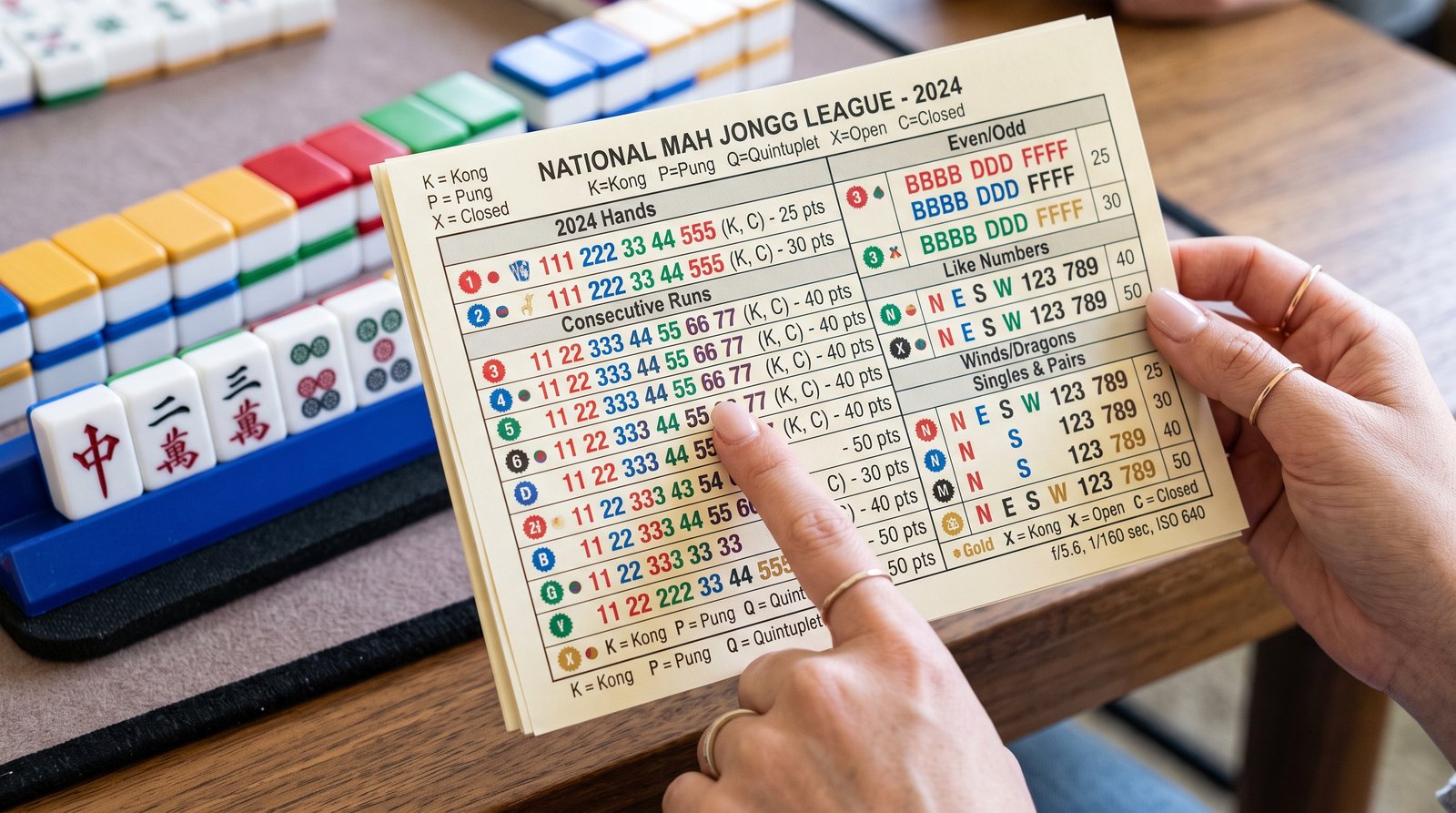
American players use a national card published every year by the National Mah Jongg League (NMJL). This card shows the official hands you’re allowed to make that year — the winning hands change annually. Chinese mahjong has none of this. The winning hands were the same when your grandmother played and they’ll be the same when your kids play.
Jokers Change Everything
Eight jokers in American mahjong. They can replace any tile except for a few special restrictions. They make the game faster and more forgiving. Chinese mahjong has zero jokers. If you need a specific tile, you have to draw it or hope someone discards it. No safety net.
Scoring Will Make Your Head Spin
American mahjong scoring is card-based, standardized, predictable. Every hand on the NMJL card has a specific point value. Chinese mahjong scoring varies wildly by regional variation — from simple Hong Kong scoring to International Competition Rules that could fill a small novel.
Pung, Kong, Chow — Same Words, Different Rules
Both games have pung (three of a kind), kong (four of a kind), and chow (a sequence). But American rules restrict when and how you can call them, and exposure limits point values. Chinese versions are more flexible but have their own regional nuances.
Social Vibe — Completely Different
American mahjong is social. People chat, banter, snack. It’s often played in community centers and living rooms. Chinese mahjong can be social too, but there’s a competitive intensity to it — tile slamming, fast play, serious focus. I love both for different reasons.
Which One Should You Learn?
Both. Start with whichever fits your personality. If you like structure and clear rules, American mahjong is your game. If you like depth, tradition, and zero safety nets, go with Chinese. Either way, you’re in for a masterpiece. Try American Mahjong online to get started.
Frequently Asked Questions
Which is harder to learn: American or Chinese?
Chinese (specifically Riichi) is harder to learn due to complex yaku (scoring patterns) and the furiten rule. American has simpler scoring but requires memorising the NMJL card.
Can you use the same tile set for both?
No. American sets need 152+ tiles including 8 jokers. Standard Chinese sets have 144 tiles and lack jokers.
Which is more popular?
Chinese variants (especially Riichi and Hong Kong) have more players globally. American Mah-Jongg is most popular in the United States, particularly among Jewish-American communities.